The Story Behind Apple's 1984 Ad
Tom Hormby
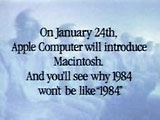
Apple became a household name in the third quarter of SuperBowl
XVIII when it aired the enormously popular 1984 ad promoting the
upcoming release of the
Macintosh.
Apple's PR firm, Chiat/Day, had pitched a similar ad in 1982 to
promote the Apple II. The basic premise was that the Apple II would
only enable people, and not hinder them with inane commands and hard to
understand interfaces.
 No executives were particularly enamored with the spot, and it was
filed away for possible later use.
No executives were particularly enamored with the spot, and it was
filed away for possible later use.
A year later, Chiat/Day was tasked with creating an advertising
campaign for the upcoming release of the Macintosh. The agency prepared
a spot titled Manuals that featured an IBM XT and a pile of the manuals
which were bundled with the computer. The camera would then show a
Macintosh with its single user's guide floating down to land near the
mouse.
The ad didn't find many champions in the corporate hierarchy, so
Chiat/Day, on the advice of Steve Jobs, restarted production of the
shelved 1984.
 Jobs wanted a blockbuster for his product. Chiat/Day's copywriter
and art director, Steve Hayden and Brent Thomas, created a tentative
storyboard to present to the newly installed John Sculley for approval.
The storyboard featured hundreds of men listening to Big Brother on a
huge screen delivering a speech on the virtues of censorship. In
mid-speech, a model runs into the room and destroys the screen with a
baseball bat, freeing the men from Big Brother's grasp.
Jobs wanted a blockbuster for his product. Chiat/Day's copywriter
and art director, Steve Hayden and Brent Thomas, created a tentative
storyboard to present to the newly installed John Sculley for approval.
The storyboard featured hundreds of men listening to Big Brother on a
huge screen delivering a speech on the virtues of censorship. In
mid-speech, a model runs into the room and destroys the screen with a
baseball bat, freeing the men from Big Brother's grasp.
Steve Jobs was thrilled with the commercial. He thought that it
would generate a buzz for the Macintosh without even featuring the
product itself.
Sculley, the creator of the Pepsi Challenge and Pepsi Generation
while he was VP at PepsiCola (PepsiCo's beverage wing), disliked the
ad, but was willing to defer to Jobs. The ad was approved, and
Chiat/Day was told to buy the airtime during SuperBowl XVIII.
Chiat/Day hired Ridley Scott (Alien, Blade Runner) to direct
the commercial, and the agency was given a budget of $900,000 to
produce 1984 and an ad for the Lisa titled Alone Again.
Shooting began in September in Scott's native Britain. He assembled
a cast of British skinheads to populate the auditorium where Big
Brother delivered his speech. Unfortunately, Scott was unable to get
the necessary number, so he paid amateurs $125 a day to shave their
heads.
Casting for the heroine was more difficult. The baseball bat had
been swapped for a more dramatic (and unwieldy) sledgehammer. The
models that showed up for the casting call were physically unable to
throw the sledgehammer safely or attractively. Luckily Anya Major, an
experienced discus thrower, tried out for the part.
The ad was the pride of the entire agency. They were confident that
1984 would generate a tremendous interest in not only the Macintosh,
but all Apple products.
Unfortunately, Apple's board didn't concur. When the board was shown
the ad, cofounder Mike Markula suggested that Apple drop Chiat/Day
altogether. The rest of the board was not impressed either.
Sculley was discouraged by the board's reaction and asked Chiat/Day
to sell back both the timeslots to CBS (the commercial was to air uncut
during a minute spot, and an abreviated version would be aired during a
thirty second spot). If a buyer could not be found, Manuals would be
run instead. Chiat/Day defied Sculley and only sold the thirty second
spot.
Steve Wozniak, who was still friends with Jobs at the time, heard
about the board's refusal to support the adfrom Jobs, who also showed
it to him. Wozniak loved the ad and offered to pay for the spot
personally if Jobs was unable to get Apple to air the ad.
When Jobs told Sculley of Wozniak's support, he gave the decision to
marketing manager, Bill Campbell (future CEO of Intuit), who loved the
ad. Manuals was scrapped.
 Contrary
to popular belief, 1984 did not run just once. In order to
make it eligible for Cannes, Apple bought airtime on KMVT in Twin Falls
Idaho at 1:00 AM in December 1983. On January 22, six weeks later, the
ad aired for SuperBowl XVIII (between the Redskins and Raiders in Tampa
Bay), and it was a sensation. The ad was awarded the top prize at
Cannes and was replayed constantly on news programs following the game.
Chiat/Day estimated that 1984 generated over $5 million in free
publicity.
Contrary
to popular belief, 1984 did not run just once. In order to
make it eligible for Cannes, Apple bought airtime on KMVT in Twin Falls
Idaho at 1:00 AM in December 1983. On January 22, six weeks later, the
ad aired for SuperBowl XVIII (between the Redskins and Raiders in Tampa
Bay), and it was a sensation. The ad was awarded the top prize at
Cannes and was replayed constantly on news programs following the game.
Chiat/Day estimated that 1984 generated over $5 million in free
publicity.
Response to
the ad was so strong that Apple bought months of ad time on
ScreenVision, a company that sold ad time in movie theaters. Some
owners reaired the ad for months after Apple's contract ran out with
ScreenTime because they were so enamored with the commercial.
The 1984 ad is considered the greated commercial in the history of
the SuperBowl, and it was updated in 2004 - the ad's 20th anniversary -
to include an iPod.

